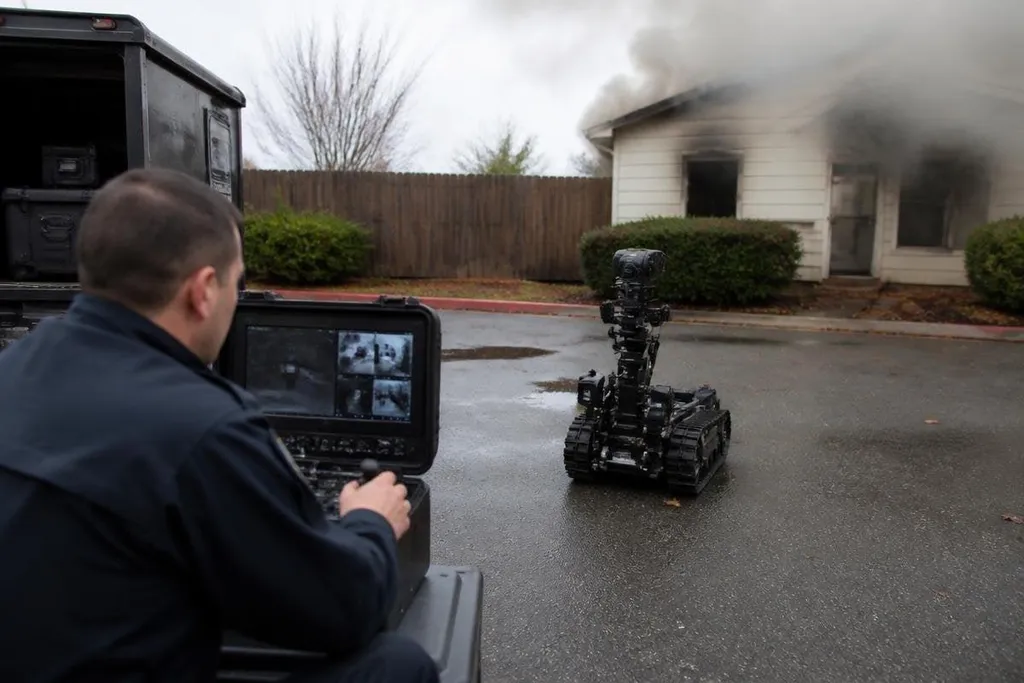
A police robot could move toward a suspected bomb, armed person, or burning building before an officer has to enter. Its first job would be simple: give the team better information while keeping people farther from the hazard.
It would not replace judgment. It would carry cameras, sensors, a speaker, or a tool into places where a person may face immediate harm.
Quick read
- A remotely controlled robot can inspect a dangerous area while officers stay behind cover.
- Its value depends on clear video, a steady control link, and tools suited to the scene.
- Police need rules for search, recording, force, failure, and public review before use.
What the robot would do first
The first task is looking. A tracked or wheeled robot could enter a hallway, vehicle, room, or open area while sending video to an operator. A speaker could let the operator give instructions without moving closer.
That distance matters because the operator can pause, reverse, or ask for more information before anyone enters. Its equipment may include a light, microphone, chemical sensor, or camera mounted on a movable arm, but the right equipment depends on the hazard.
A robot can also check a suspected package from several angles. The operator might inspect its shape, wires, movement, or location without touching it. Those observations would not prove what the package is, so a trained bomb team would still need to decide what happens next.
Remote control matters more than autonomy
Police work needs context. A person may need to tell the robot where to look, avoid a child in a room, or stop when a nearby officer loses sight of it. That makes remote control a safer starting point than allowing the robot to act on its own.
Autonomous functions can still help with narrow tasks. The robot could hold a steady position, keep its camera pointed at a doorway, or return along a known route when the control link weakens. Those functions should support the operator rather than make decisions about people.
The control link is a weak point. Walls, distance, interference, or damage could delay video and commands. A police team needs a clear signal warning, a safe stop, and a way to bring the robot back without sending someone into the hazard.
That control link also limits the tools police can carry. Robot24.com police robotics reporting can connect a robot’s camera, speaker, arm, or less-lethal tool to the test setting, operator input, and rules for use. Those details matter before the next section weighs how added tools can raise the risk.
Tools create a higher risk
A camera gives information. A tool can change the scene. That difference matters when a robot carries a loudspeaker, a door-opening arm, a water hose, or equipment intended to stop a person.
Each tool needs its own rule. Officers should know who may activate it, what warning comes first, and what record the system keeps. A robot that can push, pull, spray, or restrain someone needs closer review than one used for viewing only.
The machine also needs a clear limit. It may not climb stairs, cross loose ground, fit through a narrow doorway, or work in smoke.
A camera view can miss a person outside the frame, and a robot can make noise that changes how people inside the scene behave.
What proof should look like
A department should ask for evidence from the exact type of work it plans to do. A warehouse test says little about a stairwell, a dark room, or a damaged building.
Useful proof would include repeatable tests with the control link partly blocked, low light, uneven floors, and a stopped robot. The team should also record how operators train, how long setup takes, and what happens when a sensor or motor fails.
The public needs a record too. That means rules for video storage, access, deletion, and requests from people recorded by the robot. Police should explain the robot's purpose before routine use, not after a disputed incident.
A practical decision check
Before buying or using a police robot, ask:
- Scene fit: Can it reach the places named in the department's plan?
- Control loss: Does it stop safely when video or commands fail?
- Operator load: Can one trained operator drive it and read its sensors?
- Tool limits: Does each attachment have a written approval rule?
- Public record: Are recording, storage, and review rules in place?
I'd keep the first police robot focused on viewing, speaking, and carrying sensors. Those jobs can reduce exposure to danger without giving a machine broad control over a person.
The next useful test is not a polished demonstration. It is a repeatable exercise where the robot loses its signal, meets a blocked route, and still leaves officers with a safe choice.